Anyone requesting software quotes for the first time tends to receive very different documents for the same request: one with a single line and a figure, another with twenty pages of technology and no price per item, a third with estimated hours nobody knows will be enough. Comparing them like that is close to impossible.
This article shows what a custom software quote should break down, with a line-by-line example, so you can read any proposal, ours or someone else's, and understand what you are actually buying.
Short answer
A custom software quote should separate at least these line items:
- Discovery and system design
- Development, split by module
- Integrations with the systems the company already uses
- Data migration
- Testing
- Training and go-live
- Support included after delivery
- Recurring costs, including those not paid to the supplier
And for each one it should say what is left out. In figures, a first module of custom management software typically falls between €15,000 and €30,000, a management system with several modules between €30,000 and €60,000, and a core business platform from €60,000. If the company already has a working prototype built with AI, discovery and design shrink and the figure comes down, as we explain further below.
The line items, one by one
| Line item | What it should include | What to ask |
|---|---|---|
| Discovery and design | Conversations with the people who run the process, a map of rules and exceptions, screens designed and approved before coding | Will I see and approve the screens before you start building? |
| Development by module | Each module with what it does, for example "orders", "invoicing", "customer area" | What happens if a module grows halfway through? |
| Integrations | Each connected system (ERP, invoicing, email, portals) and which way the data flows | Does the old system have a ready-made connection, or do you need to work on its database? |
| Data migration | Which data moves, from where, how many years of history, who cleans up duplicates | Who checks that the data arrived correctly? |
| Testing | Tests with real business cases, not just sample data | What data will you test with? |
| Training and go-live | Sessions with the team, a period where the new and old systems run side by side | How long will you support the team in the first weeks? |
| Included support | Duration, what it covers (bugs, questions) and what it does not (new features) | What does it cost once the included period ends? |
| Recurring costs | Hosting, third-party licences, maintenance | Whose name are the hosting accounts in? |
Notice that none of these items is about technology. The programming language and the database matter to the team building it. What matters to you is what the system does, what it connects to and what happens when something goes wrong.
A line-by-line example
To make this concrete, here is an illustrative quote for a distribution company that wants to replace its order spreadsheets with a first custom module, connected to the invoicing program it already uses. The figures are an example within the ranges we publish, not a real proposal.
| Line item | Detail | Amount |
|---|---|---|
| Discovery and design | 2 weeks: interviews with sales and warehouse, per-customer pricing rules, approved screens | €3,000 |
| Orders module | Order entry, statuses, per-customer prices and discounts, stock alerts | €9,500 |
| Customer area | Customers check orders and invoices and repeat past orders | €4,500 |
| Invoicing integration | Approved orders sent to invoicing, payment status read back | €3,000 |
| Data migration | Customers, products and 2 years of orders from the current spreadsheets | €1,500 |
| Testing with real cases | Last month's real orders replayed in the new system | €1,500 |
| Training and go-live | 3 sessions and 2 weeks with both systems running in parallel | €1,000 |
| Project total | Fixed price, paid in three milestones | €24,000 |
| Included support | 3 months after delivery | Included |
| Hosting | Company's own account, in the European Union | €50 to €150 per month, estimate |
| Maintenance after support | Fixes, security updates, small improvements | Optional, quoted separately |
Three things to take from this example. Development is the largest part, but far from all of it: discovery, integration, migration, testing and go-live add up to almost half. The integration has its own line, because that is where most projects overrun, especially when the other side is an old system nobody wants to touch. And the monthly costs are written down, even though hosting is paid directly to the cloud provider.
What if you already have a prototype built with AI?
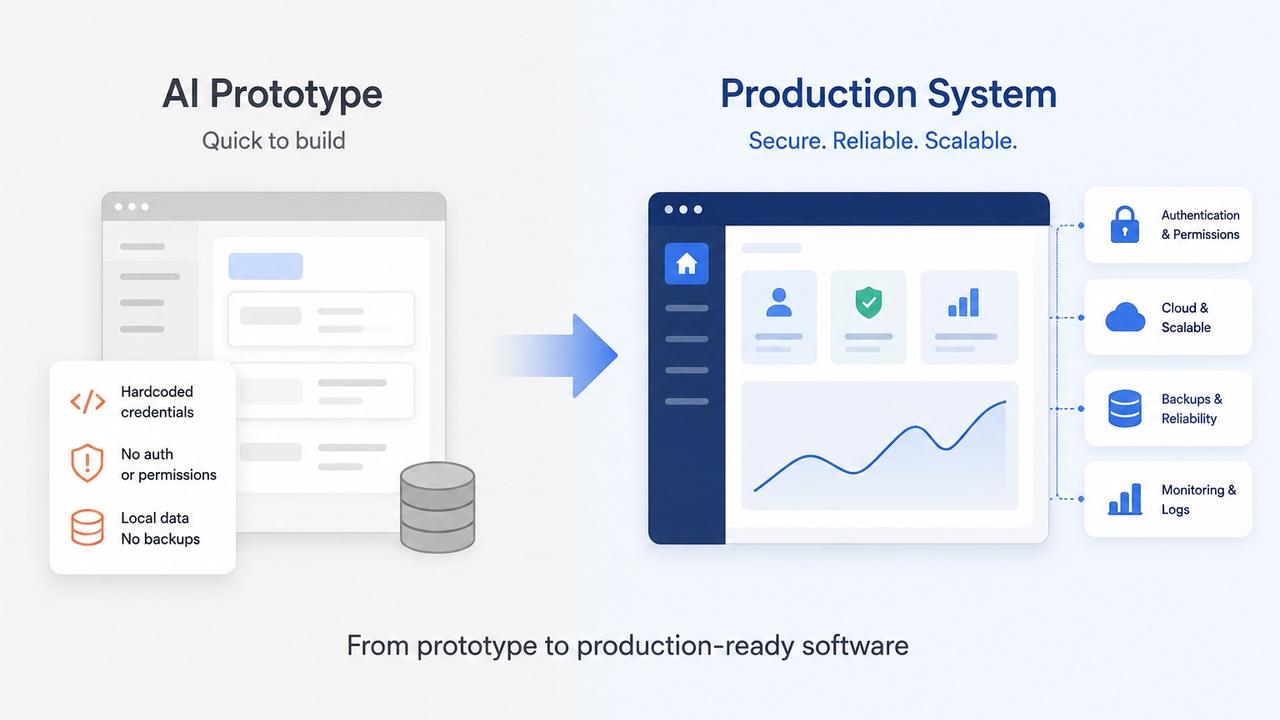
More and more companies arrive at the first conversation with an application already working. Someone on the team opened ChatGPT, Claude, Gemini, Lovable or Cursor and, after a few afternoons, has an order log, a customer portal or a dashboard that brings together numbers that used to live in five spreadsheets. It is not ready for the whole company to use, but the prototype is not wrong, it is incomplete.
For the quote, this is good news. The prototype answers a good share of the questions discovery exists to answer: which screens are needed, what data is kept, which rules and exceptions the process has. Whoever built it already knows what they want, and you can see it working rather than read it in a document. The result is that the discovery and design line shrinks, there is less risk of misunderstandings halfway through, and some of the screens and rules can be reused in development.
In the example above, a company that brought the order log already designed in a prototype could see discovery drop from €3,000 to around half, and the orders module cost less because it starts from screens and rules that have already been validated. The figures are still illustrative, but the logic is this: you pay less for the part the client has already done.
What the prototype does not remove are the line items no prototype brings, because it was not built for that:
- individual user accounts, where each person only sees what they are allowed to;
- real data in a proper database, with tested backups;
- the connection to the ERP, invoicing or CRM;
- testing with real cases and a record of what happened when someone says something went wrong.
So a good quote for someone who brings a prototype has one extra line: what is reused and what is rebuilt. It should say which screens, data and rules carry over into the final system and what has to be built anew. For a defined scope, taking an AI-built application to production typically costs between €7,500 and €15,000 for a first version.
If you have a prototype, you do not need to tidy it up before asking for a quote. A link, a two-minute screen recording or a few screenshots are enough for the first conversation.
What is left out, and should be written down
The costs that surprise people most after signing are almost always the same:
- Hosting: servers, database and backups. For a mid-sized management system it typically runs from a few tens to a few hundred euros per month.
- Third-party licences: email and SMS sending, maps, digital signatures, AI models. They are pay-as-you-go and grow with volume. If the system uses AI, see how much it costs to keep AI running in a company.
- Maintenance after the included period: security updates and fixes are still needed, even if nobody asks for anything new.
- Out-of-scope changes: whatever is discovered halfway and was not in discovery. A good quote says how they are handled and at what price.
If the proposal mentions none of these, it does not mean they do not exist. It means you will find out about them later.
Fixed price or time and materials
With a fixed price, the builder carries the risk of the work taking longer than planned, as long as the scope does not change. To do that they need to understand the process well before giving a figure, which is why a serious fixed price almost never appears in the first meeting.
With time and materials, you pay for the time actually spent. It can make sense when the problem is not yet clear, but the risk of overruns moves to your side. If that is the model, ask for a cap and for hour reports per line item.
In our projects the price is fixed and does not change along the way. When something new comes up, it moves to a later phase or goes in at a price agreed before the work is done.
How payment works
The most common approach is to pay in milestones tied to deliveries, not dates. A usual split is 30% at kick-off, 40% halfway and 30% on final delivery, and on larger projects the milestones follow the partial deliveries. That way each payment matches something you have already seen working.
Warning signs before signing
- A single line with the total. There is no way to compare or to negotiate scope.
- No integrations line when the system has to talk to the ERP or invoicing. Either the work has not been understood yet, or it will show up later.
- Nothing about who owns the code, the hosting and the data. They should be in your company's name, with documentation, so you can change supplier without renegotiating anything. There are more questions like these in how to choose who builds your company's systems.
- Full payment before seeing anything working.
- A deadline with no phases. Custom management software projects typically take between 8 and 16 weeks. See how long a custom software project takes to understand what is reasonable for your case.
How to compare two quotes
Put the proposals side by side against the eight line items above and mark, for each one, what is included, what is excluded and what is not even mentioned. The cheapest proposal is often the one with the most blank lines. Then add three years of recurring costs to each: that is the figure you will actually pay.
If one of the alternatives is a monthly licence rather than custom software, the calculation changes shape, because the cost grows with the number of users. We compare the two paths in custom CRM or Salesforce and in custom ERP or Primavera, PHC and SAP.
If you want a price reference by project type, the custom software cost guide has the ranges for CRM, ERP, portals and automation, plus a simple calculation to compare against a monthly licence.
How we do it
Before any figure, there is a 30-minute conversation to understand the operation, the systems you use and where time is being lost. If it makes sense to go ahead, within 1 to 2 weeks you receive a proposal with the scope, the timeline and a fixed price, broken down by these line items. If you already have a prototype, bring it: the proposal states what is reused and how much that takes off the price. If the numbers do not add up, we tell you in that same conversation.
The diagnosis is free and does not commit you to anything. Request yours here.