It is a quarter past eight in the evening and the lights are still on in three consulting rooms. The last appointment finished at seven, but the doctor who saw it is finishing the notes for the eighteen patients she saw during the day, the physiotherapist is writing up the afternoon's progress notes and, in the room at the end of the corridor, someone is preparing the referral letter the four o'clock patient needs for tomorrow. Nobody complains out loud, because it has been like this for years. The clinical director knows this is time that never turns back into consultations, and also knows, if they ask carefully, that at least one of the clinicians is already pasting notes into an AI assistant on a personal account to "get it done faster".
That second point is usually what starts the conversation. The appetite for using AI to write less already exists inside the clinic. The real question is whether it happens by design, with the data in the right place and the clinician in control, or informally, with health data moving through tools nobody has assessed.
Short answer
AI can already take a large share of record-keeping time off clinicians, as long as it works as a draft and not as the author of the note. It listens to the consultation or the dictation, returns a structured note in the specialty's format and prepares letters and reports, and it is always the clinician who reviews, corrects and signs. To stay on the documentation side, the system records and rewrites, never suggests diagnoses or doses, and the data stays in the European Union, with no retention or training. A first use case in production typically falls between €7,500 and €15,000.
A good draft, signed by the clinician
A clinical documentation assistant listens to the consultation (or to the clinician's dictation), transcribes it and returns a structured draft in the format that specialty uses: presenting complaint, history, examination, plan, or the progress note for a physiotherapy session, or the tooth-by-tooth record of a dental appointment. From the same material it prepares what comes next: the report for the insurer, the letter to a colleague, the summary for the patient. Before the next appointment, it can pull into a single paragraph what is spread across years of records.
What it does not do is decide. The final text always belongs to the clinician, who reads, corrects and signs it. This is not a decorative safeguard: it keeps clinical responsibility exactly where it sits today, and it also helps keep the system on the right side of a regulatory boundary we cover further down.
Signs your clinic has this problem
- clinicians regularly stay on after the last appointment to write up notes;
- some notes are written the following day, from memory, with less detail than the consultation had;
- referral letters and insurer reports pile up and go out days late;
- the clinician spends part of the consultation facing the screen instead of the patient;
- before every follow-up, someone manually works through years of records to understand where things stand;
- coding of procedures and diagnoses for billing is done at the end of the month and leads to rejected claims;
- you already know, or suspect, that some staff use personal AI tools with patient data.
Where these systems fail, and how to design around it
Transcribing European Portuguese with clinical vocabulary, which is what clinics in Portugal need, already works well enough to be useful, especially with a good microphone in the consulting room. What separates a useful system from a dangerous one lies in the errors that remain, because they are errors that look like correct text.
Negations and laterality. "Denies chest pain" and "reports chest pain" differ by one word, just as right knee and left knee do. In a fluent draft, these swaps slip past anyone reading in a hurry. That is why every sentence in the draft is linked to the transcript excerpt it came from, and sentences containing a negation, a side of the body, a dose or a numeric value are flagged for review.
Findings nobody mentioned. A model trained on millions of notes knows that a routine consultation "usually" includes normal auscultation. If the doctor did not mention it, the draft cannot include it. The rule we apply is simple: a field with no source in the consultation stays empty, and empty looks visibly different from normal.
Medicines, doses and units. Similar brand names, milligrams confused with millilitres, "twice" heard as "three times". We check medicine names against the list the clinic actually uses and flag every dose for explicit confirmation. Prescribing still happens in the system built for it, never from the draft.
Who said what. In a consultation the clinician, the patient and sometimes a relative all speak; in veterinary practice it is the owner. What the patient reports and what the clinician observes have to sit in different sections, or the note ends up attributing to the examination something that was only a complaint.
The indicator that best shows whether the system is working is not transcription accuracy, it is the edit rate: what percentage of the draft the clinician changes before signing, and in which sections. When one section is always rewritten, the problem lies in the note template, not in the clinician.
The line between documentation and clinical decision support
This is the part most often treated lightly, and the one that can cost the most. Regulation (EU) 2017/745, the Medical Device Regulation (MDR), applies to software whose intended purpose is to support diagnosis, prevention, monitoring or treatment. Whether a system is a medical device depends on the purpose it is designed and presented for, not on the fact that it uses AI.
| Function | What it does | Tendency |
|---|---|---|
| Transcription and draft note | Records what was said, for review and sign-off | Closer to documentation, but needs assessing |
| Letters, reports, patient summary | Rewrites information already validated by the clinician | Documentation and communication |
| History summary before the appointment | Brings together what exists, linked to its sources | Borderline if it starts to prioritise or alert |
| Billing code suggestions | Proposes procedure codes, confirmed by a person | Administrative, with mandatory review |
| Diagnosis, dose or clinical alert suggestions | Influences the clinician's decision | Likely a medical device |
The right-hand column is a tendency, not a classification. Even transcription is not automatically outside the regulation: some European clinical transcription vendors have chosen to certify their products as medical devices, precisely because the note feeds future decisions, and the question is not settled. That is why the intended purpose of each function is written down from the start of the project, so that it can be assessed by whoever provides the clinic's legal and regulatory advice.
The AI Act adds another layer. AI systems that are medical devices, or safety components of a device, and that are subject to assessment by a notified body fall into the high-risk category. Under the amendments in the so-called Digital Omnibus on AI, in force since July 2026, the high-risk obligations for products already regulated by sector legislation now apply from 2 August 2028. That buys time, but the substance of the requirements is unchanged, and how they apply to a specific system should be confirmed with your legal advisers.
Our practical position: we design documentation functions to record and rewrite, never to suggest or decide, and we put that intended purpose in writing from the start. That does not replace the regulatory assessment. If it concludes that the system is a medical device, or if the clinic genuinely wants clinical decision support, we are talking about a different kind of project, with a quality management system, clinical evaluation and CE marking, and we say so in the very first conversation.
Health data: what has to be decided before you record
Health data is a special category of personal data under Article 9 of the GDPR. None of this stops the project, but it does require a few decisions at the design stage, where they cost little. The general principles are in our article on GDPR and the AI Act before putting AI into production; in a clinical setting there are some specific points.
Permission to record. The patient has to know the consultation is being recorded and what for, and the design we advocate lets them say no without any consequence. A short request at reception or at the start of the consultation, logged in the patient record, and a mode without recording, in which the clinician dictates a summary at the end.
Where the data lives. Hosting in the European Union, in accounts the clinic controls, with contracts that rule out retention of, and training on, the data sent. Consumer tools, even paid ones, rarely offer this by default.
How long the audio lives. In most cases, until the note is signed. Keeping recordings for years increases risk without adding clinical value.
Who has access and what gets logged. Role-based profiles, a log of every access, and the draft stored alongside the signed version, so it is always clear what was generated and what the clinician decided.
The processing will very likely require a data protection impact assessment. We prepare the technical documentation the data protection officer needs; we do not give legal advice.
What usually goes wrong
Leaving each clinician to sort it out alone. This is already happening in many clinics. The result is a clinical record produced outside the clinic's systems, with no audit trail and no guarantees about the data.
Buying the tool without thinking about where the note ends up. If the draft lives in another application and has to be copied field by field into the clinical software, part of the time saved is lost in the transfer, and adoption drops off after a few weeks.
Letting the system "complete" the note. Suggesting the most likely diagnosis or the next test feels like a natural improvement. It is exactly the step that can change the regulatory status of the whole system.
One note template for everyone. The progress note for a physiotherapy session, an orthodontic appointment and a dog's vaccination do not fit the same format. A draft in the wrong structure takes more work to correct than writing from scratch.
From note template to pilot
1. Free diagnosis
A conversation about specialties, consultation volume, the clinical software in use and where most time is lost today. No commitment, and by the end it is clear whether there is a use case worth pursuing and where to start.
2. Note templates built with the people who will use them
We sit down with two or three clinicians from each specialty and define the structure of the note, what is never filled in automatically and which local expressions the system needs to recognise. This is the phase that most influences the edit rate.
3. Purpose, data and consent
We put in writing the intended purpose of each function, the patient permission flow, the retention periods and the processors involved. This is the material the data protection officer and legal advisers need to carry out their assessment.
4. Pilot with real clinicians
Two to four weeks with a small group, measuring time per note, edit rate per section and errors by type. Whatever needs adjusting is adjusted before rolling it out further.
5. Integration and roll-out
The reviewed note is written into the patient record through an integration with the clinical software, without changing systems, in the same way you add AI to the software a business already uses. Letters, reports and the history summary are added, and the system is extended to other specialties or other clinics in the group.
From first use case to clinical platform: the figures
A first use case in production, one specialty, one note template and the draft delivered alongside the clinical software, typically falls between €7,500 and €15,000, with six to ten weeks to the pilot. That is the scope of our AI for business offering. What makes that timeline shrink or stretch is explained in how long a custom software or AI project takes.
When documentation is part of a custom-built clinical platform, the figure follows the scope of that platform: between €15,000 and €25,000 for a single clinic, between €25,000 and €40,000 with integrated billing and from €40,000 for a network of clinics, on our clinic platform, which can also include the agent that confirms appointments and cuts no-shows. For veterinary practices, veterinary clinic management falls between €18,000 and €30,000.
What pushes the figure up: several specialties with their own note templates, clinical software without a ready-made connection, coding for several insurers and health schemes, and groups with different rules in each clinic. What brings it down: one dominant specialty, software with documented integration and clinicians available for the pilot. There is also a recurring cost for transcription and models, which depends on consultation volume and is estimated in the proposal.
When it is better to use what already exists
If the clinic has few clinicians, one specialty and clinical software that already includes a documentation assistant, or if there is a certified tool on the market that writes directly into that software, the sensible choice is to use it. Checking contracts and hosting is a matter of days, not a project.
Building makes sense when there are several specialties with their own formats, a group with different processes in each clinic, in-house or older clinical software, a need to link documentation to coding and billing, or data requirements that off-the-shelf tools do not meet.
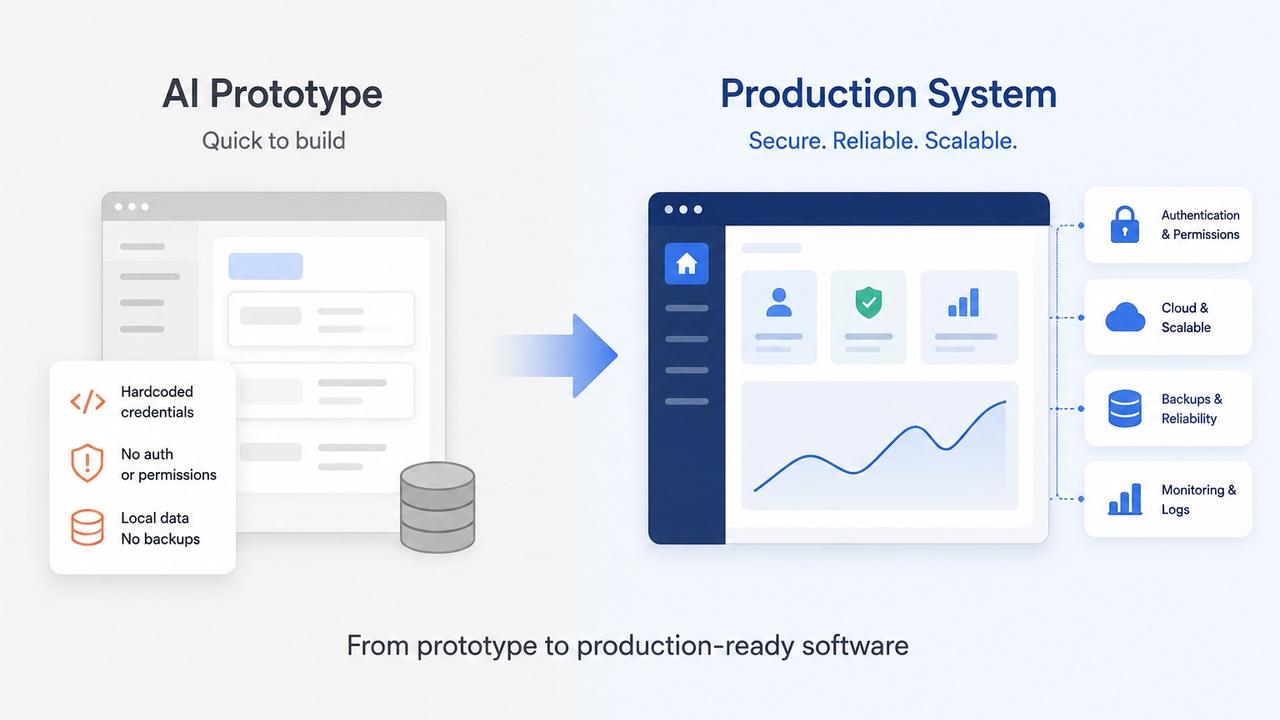
If someone at the clinic has already built a prototype of the note template in ChatGPT, Claude or Gemini, it is a good starting point and shortens the discovery work. What is missing (user accounts for each clinician, data in the right place, a connection to the clinical software, backups and tests) is exactly what separates an AI-built prototype from a system in production.
Questions to answer before moving forward
- How many hours a week do clinicians currently spend on records outside the consultation?
- Which specialties account for most of that time?
- Does the clinical software have a documented way of receiving data?
- Who in the clinic makes decisions about intended purpose and data protection?
- Would patients agree to being recorded, or is dictation the more realistic starting point?
If the lights in your clinic or group of clinics also stay on after the last appointment, you can request a free diagnosis. We look at the specialties, the software and the time being lost, with no commitment, and tell you whether there is a case for a pilot.